Skip to Main Content
Bachelor of Science (BSc)

Business Administration

Studierende des Bachelorstudiums Betriebswirtschaftslehre der Universität Liechtenstein beteiligen sich aktiv an einer Vorlesung mit Fragerunde in moderner Hörsaalatmosphäre.

with the specialisations:


Expert knowledge is important, no question. But anyone who is also willing to think beyond their own field and work as part of a team will have the best chances in their career. The bachelor’s degree programme in business administration at the University of Liechtenstein therefore not only provides you with specialist knowledge but also develops your personal skills, ensuring you are prepared for the future and remain so.

Applications can be submitted even before completing your studies with your current transcript.

Apply Now
Studierende des Bachelorstudiums Betriebswirtschaftslehre der Universität Liechtenstein beteiligen sich aktiv an einer Vorlesung mit Fragerunde in moderner Hörsaalatmosphäre.
Degree
Bachelor of Science
Programme Start
September/February
Programme Length
6 Semesters
Programme Credits
180 ECTS
Students per Semester
80-100
Tuition Fee per Semester
CHF 950-1'250
Programme Type
Full-Time/Part-Time
Programme Language
German

See for Yourself (German only)

We need your consent
To view this YouTube video, you must accept data processing under the category “Third-party marketing”. Further details on data processing can be found here.

Display Cookie Settings
Your Future Starts Here

What Makes the Bachelor Programme in Business Administration Unique

Zwei professionell gekleidete Personen in der Bibliothek der Universität Liechtenstein betrachten gemeinsam ein Buch und diskutieren dessen Inhalt, im Hintergrund Fachzeitschriftenregale.

Personal Support

You are unique and value a personal atmosphere? Then you are in exactly the right place with us.

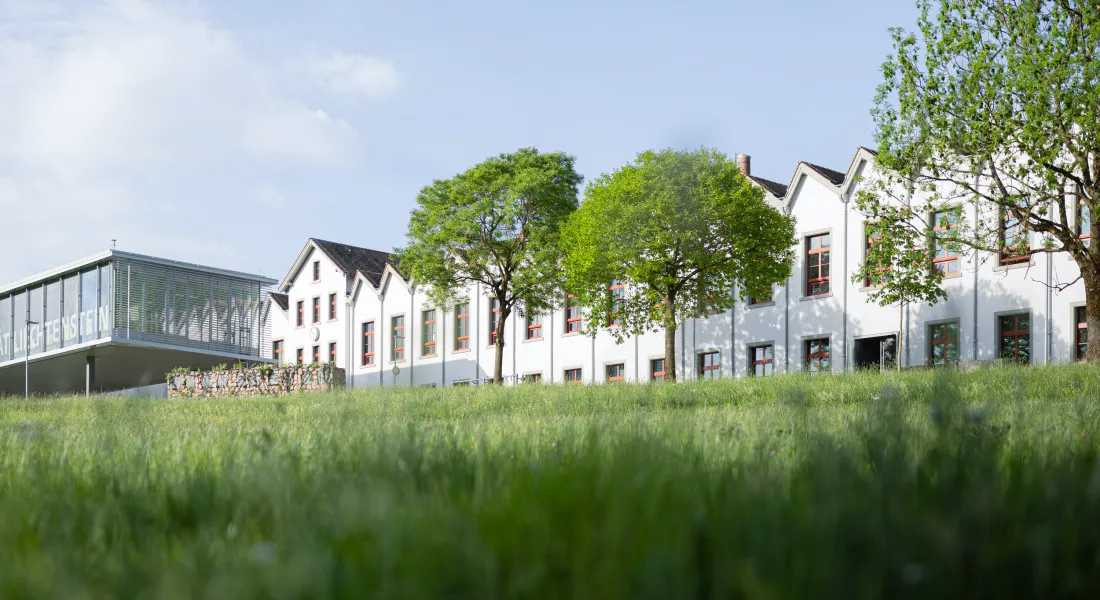
Universitaet Liechtenstein Gebaeude mit weissem Mauerwerk und gruener Wiese im Vordergrund.

Our Campus

A campus in the heart of Europe. Study with a view where others go on holiday.

Mehrere Hände halten kleine internationale Flaggen in die Höhe, darunter unter anderem die Flaggen von Deutschland, Griechenland, Schweden, Israel, Kroatien, der Slowakei, Italien und Litauen. Im Hintergrund ist ein historisches Gebäude zu sehen. Das Bild symbolisiert internationale Vielfalt und kulturellen Austausch an der Universität Liechtenstein.

International Experience

Take the opportunity to spend a semester at one of our more than 100 partner universities.

Studierende werfen Abschlusskappen in die Luft bei der Graduierungsfeier an der Universität Liechtenstein

Excellent Career Opportunities

Grow with us and actively shape your future.

The bachelor’s degree programme in business administration at the University of Liechtenstein is designed for six semesters and comprises 180 ECTS credits. The programme structure combines practical training with research-driven content and gives you the opportunity to choose between different specialisations: International Financial Services, International Management and Entrepreneurship, and Information Management and Technology. The programme is taught mainly in German. Some of the advanced courses are offered in English.

With a bachelor’s degree in business administration from the University of Liechtenstein, you will have a wide range of career opportunities. You will be well prepared for a career in national and international companies, particularly in the areas of financial services, management, consulting and information technology. The practical training and international orientation of the programme also open up opportunities to work in start-ups, international management or IT management. You will also be well positioned to pursue self-employment or take on leadership roles.

To secure a place in the bachelor’s degree programme in business administration at the University of Liechtenstein, you need to provide proof of a general university entrance qualification (Matura, Abitur) or an equivalent international qualification. Applicants whose native language is not German or who do not hold a secondary school diploma taught in German must provide proof of German language skills at level C1. In addition, English language skills at level B2 are required. Registration is completed online, and you can apply even before you receive your final certificate. For more information about application deadlines and the application process, please visit the Application and Admission page on our website.

Student life in the bachelor’s degree programme in business administration is personal, international and practice-oriented. Small groups allow for individual support and direct interaction with lecturers. Projects with companies, networking events and semesters abroad encourage new perspectives. The modern campus in Vaduz offers space for meeting others, leisure activities and shared learning in an inspiring environment.

Drei Frauen im Gespräch an einem Stehtisch beim Infotag der Universität Liechtenstein, mit Informationsmaterialien und freundlicher Atmosphäre.
Ein Student erhält bei der Anmeldung an der Universität Liechtenstein eine Willkommens-Tasche mit dem Uni-Logo
Your Journey in the World of Business starts here

Apply Now for the BSc in Business Administration

Specialisation with an International Focus

Areas of Specialisation

The Bachelor’s degree programme in Business Administration at the University of Liechtenstein offers three specialised tracks, which are taught almost exclusively in English.

The specialisation in International Financial Services focuses on the complex world of internationally active financial services companies. You analyse interrelationships within the financial environment and apply your knowledge to subject specific questions.

This specialisation prepares you for careers in banks, insurance companies, asset management companies and the development of innovative financial products.

Module 1: Financial Markets and Institutions

This module provides an overview of the financial market and the financial system. It addresses the financial market and the international financial market, market efficiency, the nature and diversity of financial intermediation and financial intermediaries. In addition, the module covers bank risks, spot lending, credit risks, selected specialised topics in lending, off balance sheet banking activities, contingent claims and securitisation, the deposit contract, deposit protection and shadow banking, the capital structure of banks and the objectives of banking regulation.


Module 2: Corporate Finance

This module covers different legal forms of business organisation, the law of one price, the time value of money, bond valuation, rules for investment decisions, capital budgeting, equity valuation, cost of capital and long term financing.


Module 3: Innovative Finance and Research Project

This module provides insights into blockchain technologies, Bitcoin and altcoins, tokenisation, crypto asset management, FinTech and current topics in financial and tax law.


Module 4: Risk Management and Financial Decision Making

This module addresses financial risk management, financial derivatives, the use of derivatives in financial risk management, expected utility theory, mean variance theory, prospect theory, non cooperative game theory, asymmetric information and market efficiency, as well as behavioural biases.


Module 5: Portfolio Management

This module covers the investment process, financial and portfolio mathematics, risky assets, mean variance portfolio theory, index models, the Capital Asset Pricing Model, the Arbitrage Pricing Theory, multifactor models, equity and fixed income securities analysis, yield curves and the efficient market hypothesis.


Module 6: International Taxation: Companies, Structures, Private Individuals

This module covers national and international corporate taxation in Liechtenstein, Switzerland, Austria and Germany. It also addresses corporate tax systems, choice of legal form and financing, group tax rate, international corporate taxation, international tax planning and European tax law.

In this specialisation, you analyse the key factors of the international environment that influence different management functions and shape them independently. The focus is on international management combined with entrepreneurial thinking.

This specialisation qualifies you for leadership positions in internationally active companies, business start ups or roles in growth oriented and export oriented companies as well as international consulting firms.

Module 1: International Management

This module is about an introduction to international business, theories of trade and investment, participants in international business, political legal and cultural aspects of international business, strategy and organization of the international firm, marketing in the global firm, current issues in international management and international management in practice.


Module 2: Innovation Seminar

Solving a practical business challenge in collaboration with a company partner is conducted in this module.


Module 3: Entrepreneurship and Family Business

This module is about foundations of entrepreneurship and family firm research, new venture creation, SME management, Entrepreneurial orientation, Entrepreneurial mindset, opportunity recognition, exploration vs. exploitation, building blocks of “Corporate Entrepreneurship” and entrepreneurial behavior in family firms.


Module 4: Digital Markets

This module is about fundamentals of digital markets, platform economics, digital transformation and changes in value creation through digitization. It also deals with strategies and principles of platform economy.


Module 5: International Economics

Following a short introduction to international economics, the module provides an understanding of the basic principles of international trade, trade policy and international finance.


Module 6: Technology and Innovation Management

The module aims at understanding technology and innovation management in companies, answering questions such as the definition of innovation and how it can be promoted or the connection between strategy and innovation. In addition to inputs in general lecture style, the students will develop and prototype a product or service based on a given technology.

The IMIT specialisation is positioned at the interface between business administration and information technology. You analyse the impact of information technology on the design of organisations and develop IT applications for companies and end consumers.

This specialisation prepares you for careers as an IT manager, business analyst or specialist in the digital transformation of companies.

Module 1: Process Management

This module conveys the fundamental building blocks of process management. Thereby, it introduces the basic stages of the process lifecycle, including the discovery, analysis, improvement, implementation and monitoring of a business process. For each stage, it will introduce tools to facilitate and improve process work.


Module 2: Enterprise Systems

This module is about benefits of enterprise systems, life-cycle of enterprise, enterprise resource planning, customer relationship management, supply chain management, supply chain management and latest technological developments. A case study on the subject enterprise processes in SAP is also conducted in this module.
 

Module 3: Information Management

This module deals with managing information, managing information systems, data mining and managing information as well as communication technology. 
 

Module 4: System Analysis and Design

This module gives an insight into the foundations of software engineering, programming, relational data modeling, object-oriented systems modeling, best practices of software engineering and programming. Furthermore this module includes a case study.


Module 5: E-Commerce

This module is about fundamentals of online trading, economical, legal and ethical aspects of e-commerce, business models differentiation of B2B and B2C, architectures and functionalities, technologies and E-government. This module also includes a case study. 


Module 6: Innovation Lab

The course covers fundamental frameworks, models, and methods with regard to innovation. Topics include managing innovation within firms, process innovation, innovation decision-making, open innovation and technology transfer, and innovation culture. A real-life case which is set up in cooperation with a company partner serves to apply knowledge on innovation management in a practical project. The developed solution should be scientifically sound and applicable in practice.

Portraifoto von Studentin Anika Schneider Bachelor BWL
At Uni.Li, I'm not just a number, my lecturers know my name. Practical training, good connections with industry, and all of that in the Lake Constance region. For me, it's the perfect choice."

Annika, Student, BSc Business Administration
Your Personal Advice

We are happy to help

Nadine Hasler, Executive Director BSc BWL
Employee